
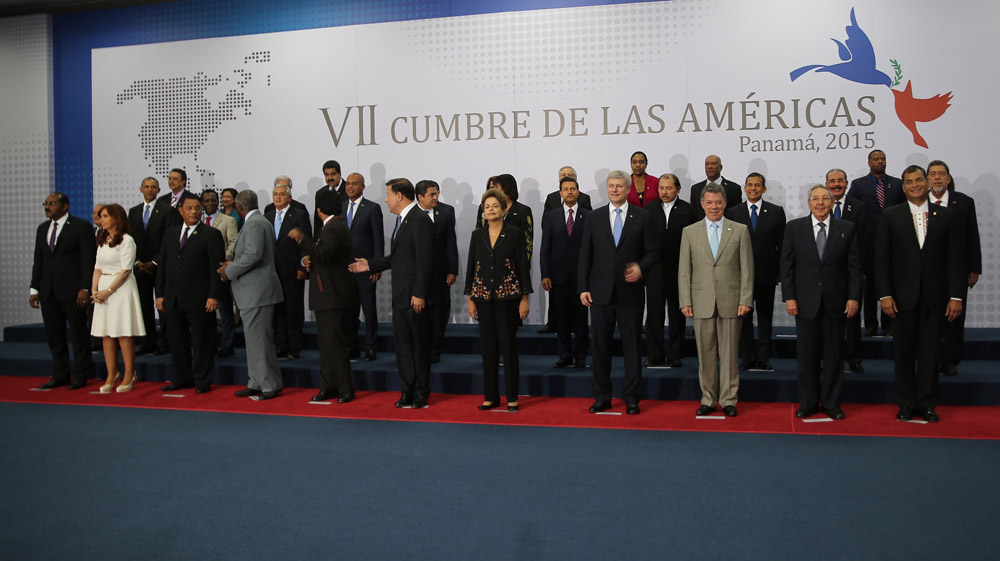
The 7th Summit of the Americas (SOA), a meeting held every three years, was held in Panama City, Panama, on April 10-12. This seventh edition was historic as it was the first time that Cuba attended a hemispheric forum where the United States was also present. The summit, named “Prosperity with Equity: The Challenge of Cooperation in the Americas” dealt with controversial topics on the hemisphere. Among those, the recent rapprochement between the Castro regime and the Obama administration, evoking reflections on the role of Mexico in the hemisphere. Mexico showed a special interest in promoting a trilateral negotiation.
This unique initiative comes as the Mexican’s committment of having a global responsibility, a policy that Enrique Peña Nieto’s administration has boosted. Middle powers like Mexico are a type of country with the capacity and willingness to take an active diplomacy to influence the international system.
The middle powers develop a responsible diplomacy based on non-structural forms of influence and are associated with the efficient use of its capabilities, including a professional foreign policy, good international reputation, well-known promoters of pacifism and multilateral activism, and specialization in specific topics such as climate change, organized crime, migration, disarmament and human rights. Cuba however, could represent what is called a ‘revolving door’. A country of this type is one that can have a crucial role in the stability of the international economic and political order. Revolving doors is not a titleholder after the country’s status and diplomatic skills, but rather after its external vulnerability and its fragile internal political balance. Cuba fits perfectly into the category of given its influence in the hemisphere, a capability that Mexico has always acknowledged in regional negotiations.
The trilateral dialogue Mexico envisages, redeems the country’s historical stand regarding the island and redeems the Mexican role as a regional power with empathy to its two in Panama City, Raul Castro referred to Obama as an honest man, while the U.S. president reaffirmed having a desire for change. Nevertheless, huge differences between the political-economic models of both countries persist over diplomatic declarations. A long and harsh road towards the complete normalization of relations awaits, which means that any catalyst, specially one with the prestige and specialization as Mexico, can be very helpful. Regarding the Summit’s host country, Panama is in the process of signing a free trade agreement with Mexico and former admission to the Pacific Alliance3 , an ambitious trade bloc with features of further integration in which Panama currently remains as observer.
Mexican delegations of businessmen and diplomats met in parallel to the summit address the toppic. In the words of Ambassador of Panama in Mexico Manuel Ricardo Perez, “the Alliance is a key agreement because Mexico is a major industrial country, and Panama is the largest distribution center in Latin America”. Moreover, President Enrique Peña Nieto shared to all participants the reforms that the administration is implementing in order to promote a prosperous society and attractive opportunities in the hemisphere. In the aftermath, eventhough the Summit did not obtain consensus for a final statement, it managed to give a breath of fresh air to the hemispheric dialogue, the unique and ideal space for regional cooperation. The attendance of the 35 Member States4 ensured the future dialogue continuity, an issue that several countries questioned during the previous SOA in Cartagena due to the exclusion of Cuba. U.S. tried to redeem it place in the region, a geostrategically important aim given the Chinese and Russian increasable presence in the neighborhood.